
Man of Peace and Good
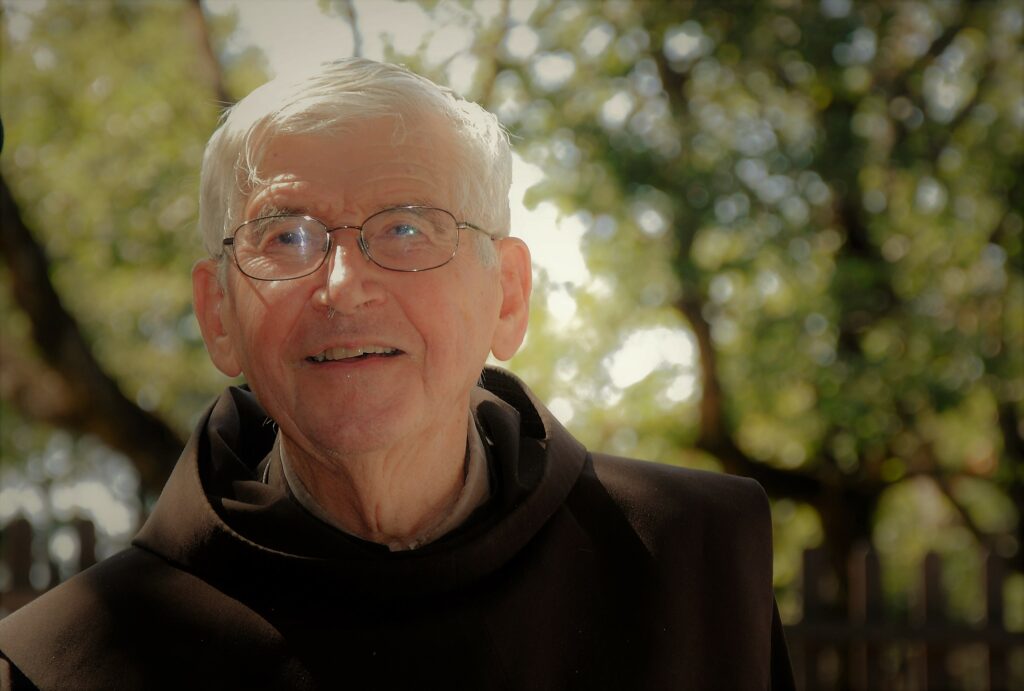
In the eight hundredth year of St. Francis’ death, a “little Francis,”1 Brother Jean-Claude Chupin O.F.M., born September 29, 1931, co-founder of the Community of the Lamb, passed away on Easter Sunday, April 5, 2026, in St. Pierre, France. Dedicated to living out and sharing the Gospel with the poor through his radical evangelical witness, priesthood, and spiritual fatherhood, Brother Jean-Claude was a burning and shining lamp (John 5:35) who gave light to all in the house (Matthew 5:15), namely to the little sisters and little brothers of the Lamb, and the thousands he encountered throughout his life of 94 years. Numerous testimonies of little sisters and little brothers, who flocked to the motherhouse from various corners of the world to accompany him in his last weeks, bring to light the portrait of this man of peace and good.
Franciscan
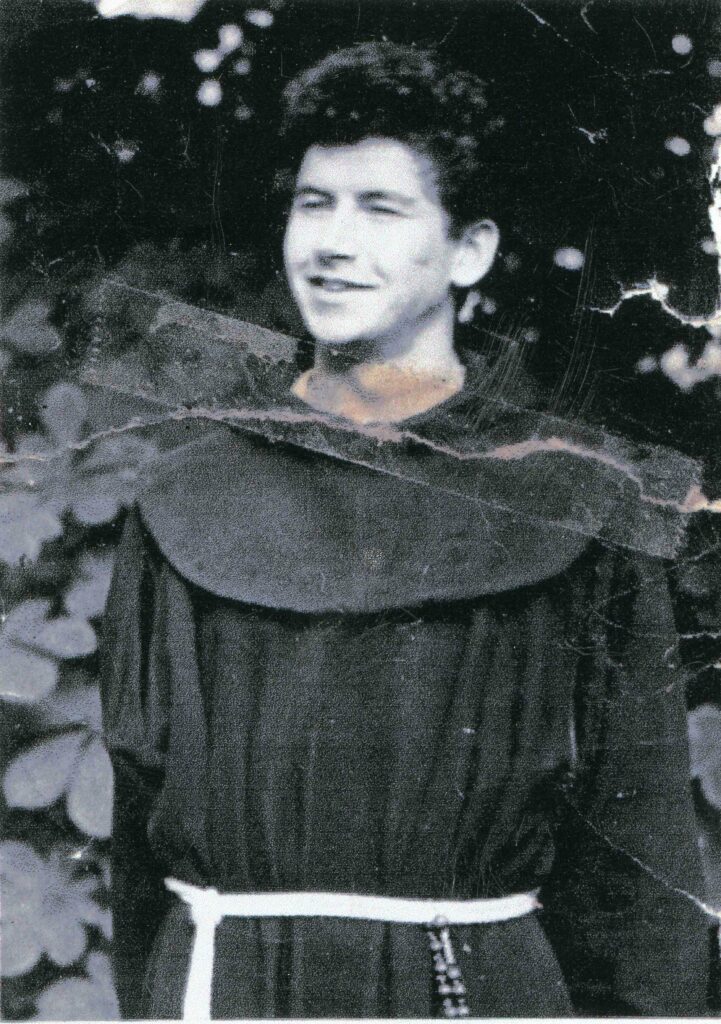
“I am Franciscan.” This undeniable truth “that fell from the highest of heaven” seized the 19-year-old Yves Chupin as he sailed along Brittany’s shoreline on a windy afternoon in 1951. “As long as I can remember, I always wanted to be a man of God,” he would tell the little sisters. He didn’t know how his vocation would unfold until this unforgettable moment on the boat. It was as if St. Francis suddenly took his younger brother by the hand and never let go. “The fog that obscured my future for years was changed by a bright and sure light,” he recounted. The call was clear and all-encompassing, and Yves responded wholeheartedly. He entered the Franciscan novitiate in September of 1952, receiving the name of Brother Jean-Claude, and professed his first vows on September 17, 1953, the feast day of St. Francis’ stigmata.
A homily he gave almost 70 years after beginning his religious life shows his joyful perseverance during this time of apprenticeship. “I was 21 years old, with many trials on my back and dreams in my head. I wanted to follow God from this interior calling, and the brothers who surrounded me repeated, ‘Bear everything with patience, Brother Jean-Claude. Nothing is urgent. The only thing to urge you on is the patient, sweet, and benevolent love of God.’2” The Franciscans who instructed Brother Jean-Claude, such as Eloi Leclerc, were for him brothers and fathers who guided him to the source. He drank deeply from his order’s heritage, memorizing and savoring St. Francis’ writings and perceiving their reflection in his studies of theology, philosophy, and spiritual life. “Right from the start, St. Francis seemed to me an evangelical man who could truly lead me to Jesus,” he said.
Brother
Church tradition recounts that St. Francis embraced St. Dominic, a key moment Brother Jean-Claude would relive 20 years into his religious life. While serving as a parish priest in 13 villages surrounding historic Vézelay, a place of pilgrimage in rural central France, Brother Jean-Claude encountered a group of Dominican sisters from the Roman Congregation of St. Dominic, who were sent to Vézelay from Paris to experience a life dedicated more fully to prayer and voluntary poverty. The Second Vatican Council, calling religious communities to rediscover their origins, sealed his heart with the conviction that “above all else, we must plunge ourselves in the Gospels so as to be personally fashioned by Christ,” as he later explained. A decisive retreat that he preached to the sisters, including the Community of the Lamb’s foundress, little sister Marie, in August 1974 intensified their mutual desire to return to the evangelical inclinations that define their respective mendicant orders. “The first encounters with the sisters put him in touch with a quest that was his own, but at the school of St. Dominic. Very quickly little sister Marie found in him a father, a brother, a friend,” explained little brother François-Dominique, prior of the little brothers of the Lamb.
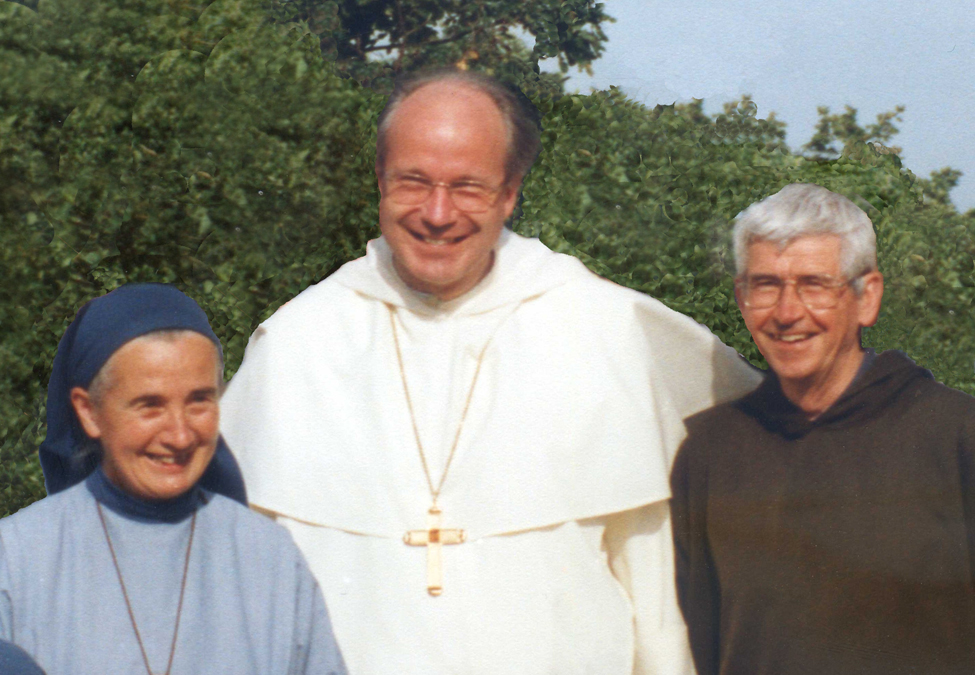
During a period of crisis that affected both the world and church alike, the fraternity of sisters was for Brother Jean-Claude a place of prayer and authentic exchange. His Franciscan brothers encouraged him to serve the sisters’ spiritual needs as they were laying the cornerstone of what would become the Community of the Lamb. His advice served to reinforce bonds of unity among the first little sisters, and likewise among the first little brothers later on. “He left an indelible mark on what was the beginning of the Community, and the journey that followed,” commented Cardinal Christoph Schönborn shortly before Brother Jean-Claude’s death. “Little sister Marie and him were very united yet at the same time corrected each other. This is something that has contributed to the wellbeing of the Community and cultivated a spirit of freedom that has made the founders beings of flesh and blood.”
Poor One
God planted in Brother Jean-Claude an ardent desire to live with the most wounded of today’s society – the homeless. “For St. Francis, it was the leper. For Brother Jean-Claude, it was the homeless.”3 Over the course of decades he asked his superiors for permission to realize this unremitting call. He was courageously persistent in his request until at last in 1982, at the age of 50, the Franciscan Order sent him forth to live in the streets day and night, accompanied by two friars. Faced with the reality of what he was about to do, he battled with his own resistance and human fragility. “When we saw him leave for the streets, it wasn’t a feat, but a yes to the Lord.”4 He humbly accepted the totality of this call, with all the vulnerability that this sort of poverty demanded, not to accomplish an ideal but to draw as close as possible to Jesus, present in the poor, and to let himself be united to Christ, poor and crucified. “Leaving for the streets, he said that he wanted to follow the movement of Christ, that of abasement. Throughout his whole life, he strove to abase himself, to live the verse, ‘he must increase, I must decrease.’” (Jn 3:30)5
To live with the homeless was to “go where there was no competition,” said little brother Jean-Baptiste, ordained a priest in 1984 by St. Pope John Paul II. Jealousies and qualms arise constantly in the world, but nobody envied the life that Brother Jean-Claude chose to live. The only privilege he sought was the privilege to live this sort of voluntary poverty. “He had a very clear purpose. He didn’t have precise activities, but a proximity to the people in precarious situations, giving him a lot of time to be in churches.”6 Hours of silent prayer and his faithful celebration of mass set the rhythm of daily life. Little brother Jean-Baptiste, who accompanied Brother Jean-Claude on many missions, said, “The simplest masses were for us an enormous source of strength.” What he brought to the streets was his rich life as a priest, peaceful countenance, and respect for the poor. “Rather than trying to say something to them, he listened.”7 When the time came to offer a word, he would oftentimes turn to his brother to respond. After all, “Jesus is the author of all evangelization,” he would write to a little sister in 1996.
During his 11 years on the streets from 1982 to 1993, Brother Jean-Claude joined the little sisters and little brothers of the Lamb multiple times throughout the year for their chapters in St. Ferréol, a hermitage in Southern France, listening to them incessantly and lovingly as they shared about founding various fraternities. These gatherings were punctuated by his fervent preaching on the Gospel. His homilies to the budding Community overflowed with his personal experiences, helping them to make a step towards the poor, towards Jesus the poor one. “Prostrating before the Poor One but not prostrating before a poor one is a contradiction that we must try absolutely to remove from our life,” he exhorted on August 1, 1989.Returning to the streets at the end of each chapter, he continued to shepherd the “Lambs” by praying for them and their families and writing to them from different corners of France, Belgium, and Italy. Brother Jean-Claude’s unassuming way of embracing this path of abjection dissipated the initial hesitancies he sometimes faced. “What are you doing here?” a group of Afghani homeless men posed their question to Brother Jean-Claude, 73 and slightly limping, and a little brother as they entered a train station in Rome during an itinerant mission in winter 2005. “Can we sleep here tonight?” the two religious asked. A tinge of resistance among the young refugees quickly melted away, giving rise to a friendly and dignified welcome. “It would be an honor to have you. Don’t worry about getting cardboard boxes. We can offer them to you, because you’re our guests!”
Padrecito
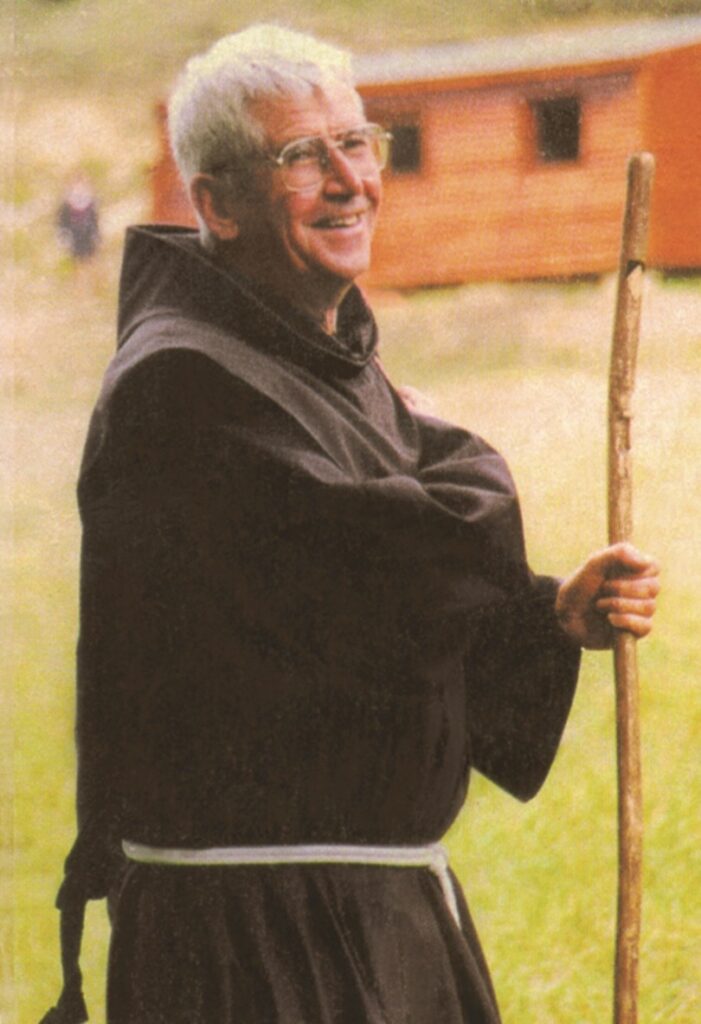
“How much I would love to die poor in the midst of the poor,” Brother Jean-Claude confided to the little brother that same evening. To not die on the streets with the poor was for him a death in itself. As the flock of little sisters and little brothers grew, he was sent by the Franciscan Order to accompany the Community of the Lamb through a greater availability as their spiritual father, settling into a modest hermitage in their motherhouse in southern France in 1994. It was a call that he never appropriated, but gradually welcomed with genuine humility. Upon his first visit to the foundation in Argentina, the poor immediately recognized in him an approachability and goodness that compelled them to call out, “Padrecito! Little father!” emblematic of the warm South-American culture that he so greatly appreciated. From thereon out, the title remained. Archbishop Emeritus Joseph Naumann of Kansas City, Kansas, described Brother Jean-Claude as a “true spiritual father who challenged, affirmed, and encouraged his children.”
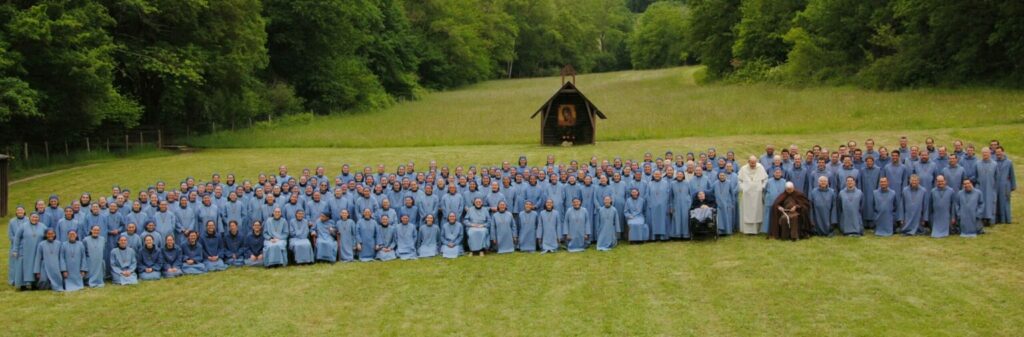
He spent hours every day listening to the little sisters and little brothers while walking the scenic paths of the Community’s countryside motherhouse. Interrupting the conversation to point out some insect or bird, he could not contain his Franciscan soul that constantly wondered at the beauty around him, “ravished by details that seemed so insignificant.”8 Brother Jean-Claude was a childlike contemplative who wanted to share with everyone the joy that he found both in creation and in scripture. “He always had the right words to put me back in a deep and solid intimacy with Christ,” a little sister shared9. “He was radiant with the light of his own friendship with Jesus and was filled with a great simplicity and interior balance. Jesus had become his own life.” The fatherhood that the five Dominicans received from Brother Jean-Claude in Vézelay would, over the course of decades, help nearly 170 little sisters and 40 little brothers embark and continue on the path of religious life.
Priest
A channel for his special grace of friendship was his priesthood. From his ordination on June 29, 1962, to the end of his life, celebrating mass remained “the essential act of every day.”10 “Be a priest of Jesus from the inmost part of your being,” he wrote to a little brother for the anniversary of his ordination. “Be a priest of Jesus every day, more and more. Let your culture be that of Jesus and his Gospel.” To be a priest was to be a missionary. Throughout his various assignments, he befriended the religious and unreligious alike. Speaking of his ten years as a parish priest in the villages surrounding Vézelay, Jean-Claude shared that he felt at home “even among those who were irreligious or agnostic. Anti-clericalism and anti-Christianity never prevented friendship, in my opinion.”
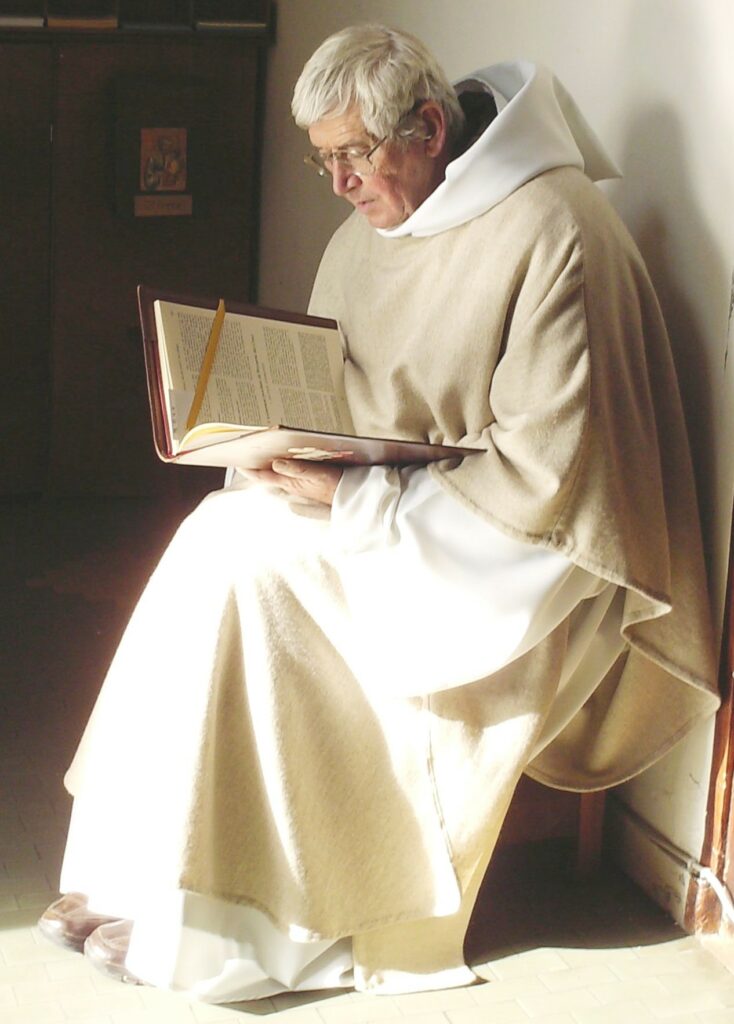
His priesthood of 64 years was intricately woven by his passion for the Word of God. “He was a man in love with the Gospel.”11 From the early days of his priesthood and onward, memorizing the Gospel of the upcoming Sunday was his sure way of preparing a homily that would lead his congregation to Christ. “The heart of his life was to give us an explanation of the Gospel from the first verse to the last verse,”12 consistently emphasizing the importance of conversion. Scribbling down word for word his fiery and oftentimes lengthy homilies was for the little sisters and little brothers an element of their ongoing formation. “Upon entering and rooting myself in the Community, his homilies breathed a great hope into my life. He never spoke to us from a higher place, but always as a brother.”13 The clarity, depth, and dynamism with which he addressed his listeners were the fruit of the hours he spent in prayer, dedicated entirely to scrutinizing the Gospel. “The one who repeats the Word for the one-hundredth time,” he would insist, “cannot be compared to the one who repeats the Word for the one-hundred and first time.”
Friend
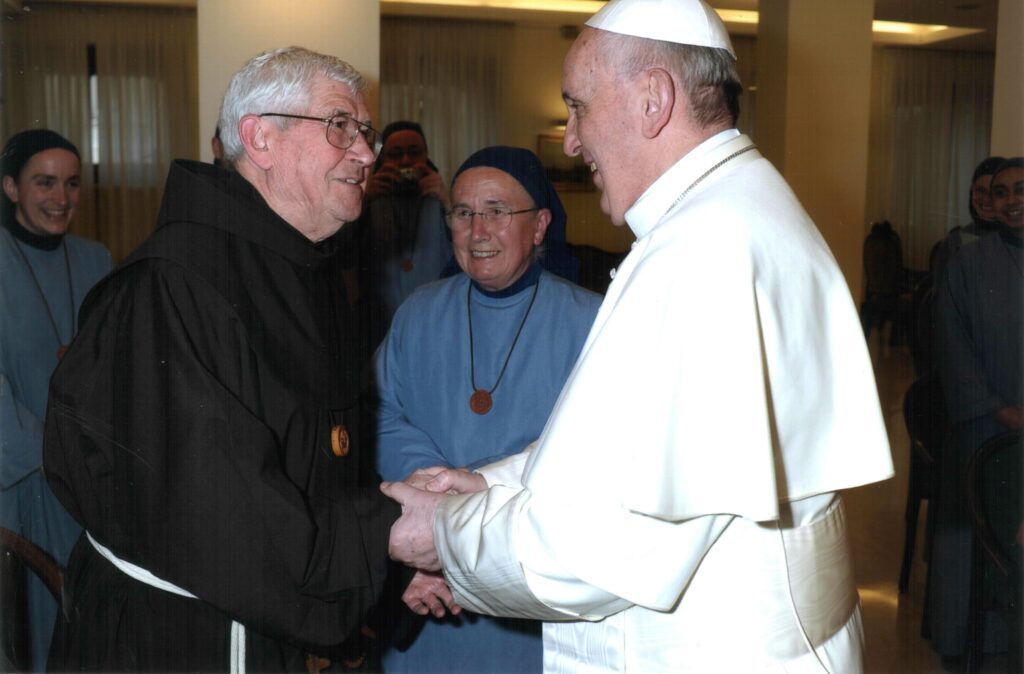
“It’s Pope Francis!” The little sister who accompanied Brother Jean-Claude to the hospital on December 23, 2023, handed him the phone, shocked. “I know you’re ill, and I am praying for you,” Pope Francis said in Spanish to Brother Jean-Claude. “Thank you! I’m praying for you too, as you always request,” he responded. A simple friendship was kindled through a series of personal encounters between Pope Francis and the Community of the Lamb, both in Argentina before his Papacy and in the Vatican just two days after his election in 2013.
“He lived and breathed happiness,”14 so it’s no surprise that the small and great alike were marked by his amiable presence. His profound joy derived from his concrete choice to live out Jesus’ commandment: “Love one another as I have loved you” (Jn 13:34).
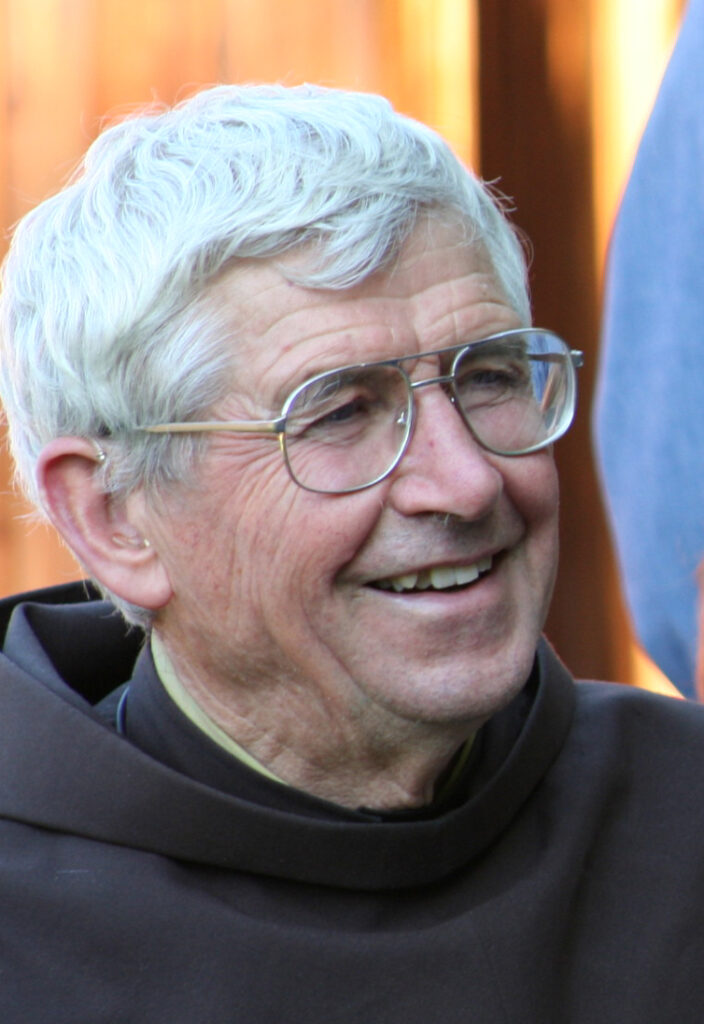
Some weeks before his death, an atheist fireman with whom he served in Vézelay 48 years prior inquired news of Brother Jean-Claude, who naturally drew close to people of diverse backgrounds and beliefs through the circumstances that life presented him, including volunteer firefighting. Those who welcomed him in their homes or helped him in any way would promptly receive a personal card. He kept the flame of friendship alive with nearly everyone he met through a faithful correspondence, writing to and speaking on the phone with hundreds, rarely leaving anyone without taking their address. “Humility is the key to friendship,” he once counseled a little sister, and he was the first to put this into practice. The firm gentleness with which he received others allowed them to share their life stories with a freedom and trust that allowed an authentic relationship to flourish.
A written testimony of his life on the streets immediately captured the heart of a young Italian Franciscan, Brother Mario Vaccari O.F.M., compelling him to write to Brother Jean-Claude asking to live a similar experience together. Brother Jean-Claude soothed the fears of the young friar as he arrived from Italy to the Community of the Lamb’s motherhouse in the summer of 1994 to then part for the streets of Toulouse. The elder watched over the younger, teaching him that the pillar upholding an itinerant life is prayer. The younger esteemed the elder, witnessing that priesthood does not distance one from the poor. Learning that Brother Jean-Claude was living his last weeks, Brother Mario, Bishop of Massa Carrara-Pontremoli since 2022, drove over 500 miles overnight to celebrate one last mass with his fellow Franciscan who, 32 years earlier, first showed him the blessing of being close to the poor. “I hold in my heart what he gave me as a very precious heritage. There were many things he taught me while living with him that have helped me to be Vicar provincial of the Friars Minor, and above all, a Bishop,” he said to the Community. The formation that Brother Jean-Claude offered him reaches today’s homeless, whom Bishop Vaccari sometimes joins to lay his head for the night.
Servant
“The Gospel! The Gospel! The Gospel!” In his last year, he began every homily by repeating the single word into which his entire life’s preaching can be distilled. As his physical capacity waned and silence grew, Brother Jean-Claude’s attachment to the Word of God and his resolve to live it could only but strengthen. “He loved the Cross and preached it with enthusiasm, not only with words but in act, carrying his own cross alongside Jesus in his service and mission,” a little sister wrote.15 Numerous surgeries and overwhelming fatigue did not extinguish his smile, hinder his zeal, or embitter his relationships.
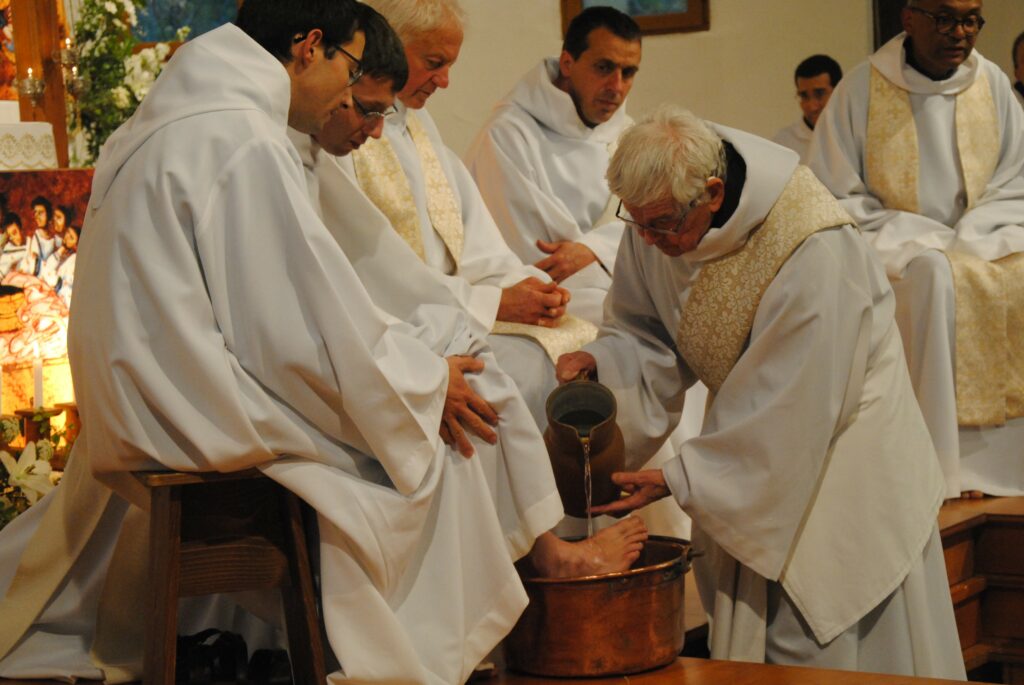
He accepted the reality of suffering with a remarkable peace and continued to welcome his many visitors generously. A simple English “thank you” or a Spanish blessing delighted the international ensemble of little sisters and little brothers, who always cherished his universal heart and sense of humor. His joyful endurance in weakness “to the end” (John 13:1) was itself a final commentary on Jesus’ complete gift of self as he washed his disciples’ feet. “Perfect praise is the offering of oneself,” he said.16
“I, too, want to lay down my life for my brothers,” were often his closing words. The conclusion of Brother Jean-Claude’s preaching became as predictable to the little sisters and little brothers as the beginning. The steady bookends of his homilies were like two doors through which he guided the Community, teaching them to first enter the narrow gate of the Gospel to then bound towards neighbor and enemy in forgiveness and fraternal charity.
The light of the Resurrection shone upon St. Pierre as the whole Community gathered around their beloved Padrecito for vespers Easter evening. Brother Jean-Claude’s abundant flock of spiritual children then remained over the course of three hours upon understanding that the Risen Christ was about to take him. The Community surrounded him with Pascal Alleluias, scriptural antiphons, and readings from St. John’s Gospel. Jesus’ priestly prayer in Chapter 17, followed by the Magnificat, enveloped Brother Jean-Claude as he offered his life to the Father. “Go into all the world and preach the Gospel to the whole creation,” Jesus exhorted his disciples in the Easter Gospel. Creation offered in turn a loving farewell to him who so ardently preached the Gospel as the setting sun cast a tender ray on Brother Jean-Claude’s face during his final moments. “Praised be You, my Lord, with all your creatures, especially Sir Brother Sun, who is the day and through whom you give us light.” St. Francis’ Canticle of Creatures sings. “And he is beautiful and radiant with great splendor; and bears a likeness of You, Most High One.”
- Witness of a little sister ↩︎
- Brother Jean-Claude, Homily on November 24, 2021 ↩︎
- Witness of a little sister ↩︎
- Ibid ↩︎
- Ibid ↩︎
- Witness of a little brother ↩︎
- Ibid ↩︎
- Witness of a little sister ↩︎
- Ibid ↩︎
- Witness of a little brother ↩︎
- Witness of a little sister ↩︎
- Ibid ↩︎
- Ibid ↩︎
- Ibid ↩︎
- Ibid ↩︎
- Brother Jean Claude, Homily on August 16, 2018 ↩︎